It is said that information is power. But in our era, where an abundance of information reigns, are we truly more powerful? Do the countless news reports, data, and posts flooding our smartphones and computer screens every day make us more informed individuals, or are they simply cluttering our minds with noise and dulling our ability to extract meaning? We can now find answers to any question in seconds—but do these answers transform into lasting understanding? These questions point to the most striking paradox of the information age: We possess more information than ever before, yet our capacity for understanding and deep thinking seems to be diminishing.
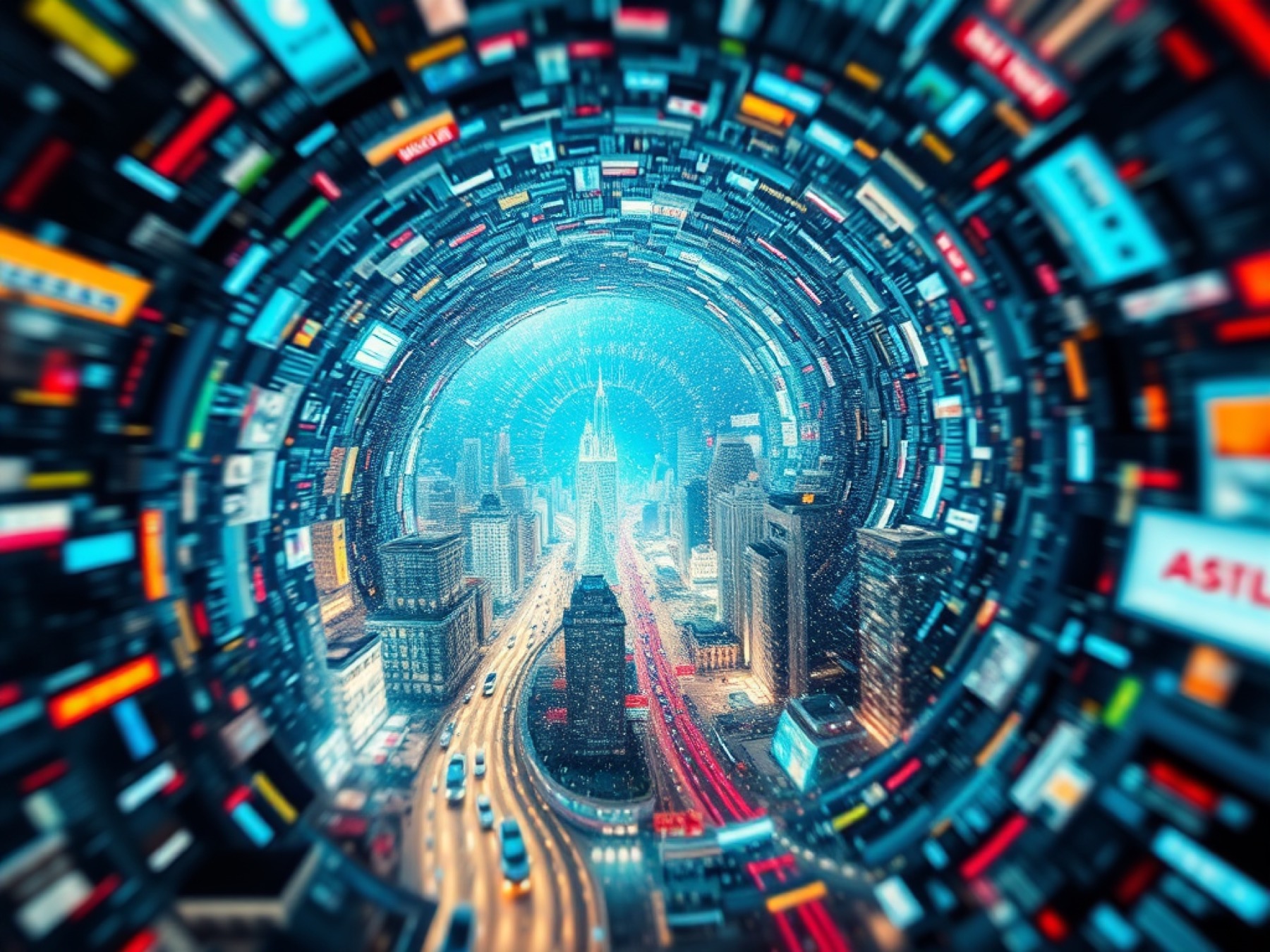
Today’s individual is trying to find their way in a world where digital data swirls like a vortex. The image above resembles the chaos created by this information bombardment. Information flows from every direction, glowing like city lights, but instead of illuminating our path, it blurs our minds. The result? Our heads are full, but our minds are confused. There is information, but where is the understanding?
The Scarcity of Understanding in Information Abundance In the 21st century, access to information has been democratized and simplified. Thanks to the internet, we can scan the equivalent of ten books’ worth of information in minutes and stay informed about the entire globe via social media. Yet, this deluge of information has brought an unexpected crisis of meaning. Philosopher Byung-Chul Han summarizes this situation: “We are well-informed, but we cannot orient ourselves. The transformation of reality into information breaks it into pieces.” When information is severed from true meaning and turns into atomized fragments, it creates clutter rather than holistic comprehension. In other words, as information increases, our ability to make sense of it weakens.
Cultural critic Neil Postman similarly states that modern society is "drowning in a sea of information," to the point where we can no longer distinguish what is truly important. According to Postman, the ever-increasing flow of information has clogged our mental "information filter," creating a kind of cultural immunodeficiency against the deluge. The resulting landscape is this: we have news about everything, but this news does not guide our lives; rather, it pulls us in like a whirlpool. In Han’s words, “Information fragments provide neither meaning nor direction; at a certain point, they cease to be information and begin to cause deformation.” That is, when information crosses a certain threshold, it stops informing and begins to obscure our existing understanding.
This paradoxical situation explains why many people feel aimless in the information age. We have a bit of information about everything, but this knowledge cannot coalesce into a coherent worldview or deep insight. The modern mind has turned into a digital junkyard; the "meaning filter" required to select and extract the gems from the heap has grown weak.
Technology and Social Media: Minds of Diminishing Depth The role of technology in accelerating access to information is undeniable. However, the deep penetration of technology into our lives is transforming the way we think. Specifically, social media and the culture of rapid digital content condition our minds to chase constant new stimuli. Feeds that refresh every few seconds, notifications, and the habit of infinite scrolling diminish our attention spans. We jump from one text to another without fully concentrating, skimming rather than reading deeply.
Technology writer Nicholas Carr, in his famous article Is Google Making Us Stupid?, confessed how years of internet usage had superficialized his own way of thinking. Carr noted that while he used to be able to lose himself in the pages of a book for hours, he now found his attention drifting after just a few pages. He argues that his mind had adapted to the fast, fragmented flow of the internet, resulting in the atrophy of his deep-reading skills. He describes this change with a striking analogy: “Once I was a scuba diver in the sea of words; now I zip along the surface like a guy on a Jet Ski.”
Linguist Maryanne Wolf is another figure who has deeply examined the effects of digital culture on our reading habits. Wolf notes that reading by constantly scrolling on screens (skimming) weakens the brain's deep-reading circuits. Deep reading acts as a bridge for the human brain to produce insight and original thought; the reader connects the text with their own knowledge, makes inferences, develops empathy, and engages in critical analysis. However, a brain accustomed to superficial reading in a digital environment becomes unable to “find the time to truly think or feel.” As Wolf emphasizes, while fast reading on screens gives us an illusion of efficiency, it lowers our level of understanding. Indeed, a large portion of academics report that their students understand texts more superficially when reading from a screen. This shows that while technology accelerates access to information, it can negatively affect cognitive depth.
The impact of social media on our world of thought is similarly superficializing. 280-character tweets, videos lasting a few seconds, endless streams of headlines... They are all content designed to grab our attention briefly and be consumed instantly. This cycle of rapid consumption vanishes without leaving deep marks on our minds. At the end of the day, we have “seen” and “read” dozens of things, but they do not transform into deep understanding. On the contrary, exposure to excessive stimuli tires the brain and dulls our desire to think. Sometimes, even lifting our heads from a phone screen to pause and think for a few minutes feels difficult.
Consuming Data vs. Gaining Insight A fundamental distinction emerges here: possessing information is one thing; possessing understanding (insight) is quite another. Today, many assume they know everything because they consume vast amounts of data and information. However, consuming raw information is not the same as digesting it and turning it into understanding. Reading a few articles online, following debates on social media, or even scanning a topic on Wikipedia presents us with data in bits and pieces. Combining these pieces to see the "big picture" requires separate effort and competence.
When Byung-Chul Han states that in modern society, disjointed fragments of information have replaced narratives, he is pointing to exactly this. According to Han, “There are no longer overarching narratives that give our lives meaning and direction; narratives have been fragmented and turned into information.” Today, we have countless crumbs of information, but they do not come together to form deep knowledge or truth. In other words, there is no story, no wholeness—only open-ended, context-free data. This leaves us feeling aimless and unsatisfied amidst all that data.
For information to turn into understanding, we must know what to do with it. Neil Postman emphasizes that computer technology provides humans with massive amounts of data but “cannot answer the fundamental questions that would make our lives more meaningful and humane.” Indeed, even the most advanced search engine cannot tell us our values, our purposes, or what is important. The answer to these questions lies in the ability to interpret data and relate it to our lives. If we do not develop this skill, even if all the libraries in the world were at our disposal, what we would obtain is merely superficial pedantry. As Postman notes, the computer age could be an immense toy that distracts us while preventing us from facing our own inner emptiness.
Today, many people have an opinion on everything, but how deep are these opinions? For instance, we immediately adopt a political slogan we see on social media and share it without thinking. Or we enter a debate about a scientific development after reading its headline without mastering the details. This haste is a sign of a lack of insight. True understanding, however, develops slowly: it requires blending the information we read with our existing knowledge, seeing contradictions, establishing cause-effect relationships, and engaging in analysis and synthesis. Unfortunately, the fast-consumption culture does not teach us this patience. On the contrary, it encourages us to constantly jump to the next crumb of information.
Algorithms, the Attention Economy, and the Erosion of Critical Thinking The digital ecosystem we inhabit shapes not only what we read but also how we think. The algorithms underlying the internet and social media are part of a ruthless race called the "attention economy." These platforms are designed to hold our time and attention as much as possible. Consequently, the "engaging" nature of information is prioritized over its quality. Algorithms try to fix our attention by showing us content that will please or shock us. This pulls our minds away from objectivity and makes us dependent on emotional reactions.
Furthermore, by offering personalized feeds based on user behavior, algorithms trap everyone within their own "filter bubble." We are presented with content that reinforces views we already hold or agree with; our chances of encountering opposing ideas or different perspectives diminish. Psychologists state that these digital echo chambers hinder critical thinking because individuals do not see information that contradicts their views. Consequently, the person feels no need to question the accuracy of their beliefs and remains within their mental comfort zone. Everything outside our own view becomes either invisible or is branded as "misinformation" and ignored. This weakens both individual intellectual flexibility and social dialogue.
We can summarize the main factors leading to the erosion of critical thinking under a few headings:
- Information Overload: When exposed to excessive amounts of information, our minds turn to simplification and generalization as a defense mechanism. This creates a tendency to accept what is seen first rather than thinking deeply. Under the bombardment of information, the individual tries to protect their mind by stopping the analysis of details.
- Confirmation Bias and Filter Bubbles: “People generally seek and produce information that aligns with their existing beliefs; an excess of information worsens this tendency.” Filter bubbles created by the influence of algorithms on social media surround the individual with content that supports only their own beliefs. This decreases tolerance for opposing views, increases polarization, and creates an illusion of “I am already right” in individuals. A person with overconfidence in their own opinion feels no need for critical thinking.
- Distraction and Superficial Consumption: The structure of the attention economy, based on constant stimulus, leaves no room for deep contemplation. Everything is consumed quickly and forgotten. This rapid cycle atrophies the habit of critical analysis, which requires patience and concentration. While the mind chases short, superficial pleasures, it begins to avoid difficult and complex thought processes.
- Lack of Critical Thinking in Education: Ironically, even as education levels rise, critical thinking skills do not increase at the same rate. While schools and universities emphasize memorizing information or teaching how to use technology, they often fail to teach students how to think. Neil Postman says that schools waste time teaching children how to use computers instead of teaching them what is truly valuable. Consequently, many diploma-holders, despite having access to information, remain insufficient in questioning and analyzing it.
When all these factors combine, a strange scene emerges in today’s information society: crowds who read much but understand little, who have many opinions but know little, who form judgments quickly but cannot think deeply... Sometimes even educated people can believe in conspiracy theories or mistake fake news for reality. Critical reasoning is replaced by hasty judgments and cognitive laziness.
Of course, this picture is not entirely bleak; there are still individuals who think deeply and question today. However, as a general trend, the sharp sword of critical thinking seems to be what the age of technology and information abundance has stolen from us. The superficialization of thought is perhaps one of the greatest crises of our time.
Conclusion: Rethinking Our Relationship with Information In the modern world, our minds are like a battlefield—on one side, the endless flow of data, and on the other, our search for meaning. As we have discussed in this article, an abundance of information does not automatically bring understanding. In fact, sometimes, on the contrary, we lose the voice of truth within the noise of information. So, is it possible to reverse this trend?
The first step might be to redefine our relationship with information in a strategic and conscious manner. Instead of constantly trying to be aware of everything, we need to focus on what is truly important. We must give ourselves time to regain the practice of deep reading and thinking. When we read a piece of news, we should stop and ask: “What does this mean? Is its source reliable? Where does this information fit into my world?” Such questions are the seeds of the process of transforming information into insight.
We must also review our digital habits. Developing digital discipline against applications that constantly distract our attention, and setting aside time to stay offline for deep reading or contemplation, is becoming valuable. Let us not forget that “deep reading is the bridge of the human species to insight and original thought”—it is in our hands not to destroy this bridge. We must make a conscious effort to burst the information bubbles we encounter on social media: being open to different views, giving a chance to content that shatters our preconceptions, and challenging our own thoughts... These are essential for the revival of critical thinking.
Ultimately, the search for meaning is at the core of being human. The challenge of the information age is to continue this search for meaning within the endless flood of data. This is more a matter of awareness and choice than a matter of intelligence. If we truly want to possess understanding, we must rethink the way we consume information and the value we place on thinking. Accepting how little we actually understand about all the things we think we know can be the beginning of a shift toward a new style of learning and thinking.
Perhaps we should ask ourselves this critical question: Within all this information, what have we truly understood? If the answer to this question is not satisfactory, it is time to stop and correct our course. We do not have to surrender to the superficialization of thought in the age of technology. We can regain control of our relationship with information. Slowing down, going deep, making connections, questioning... These are the methods of finding understanding again.
In conclusion, if we ask "there is information, but where is the understanding?", the answer is hidden in our attitude. Understanding stands there like a treasure waiting to be found—but to obtain it, we must use our attention, time, and minds strategically. When we choose to stop being passive consumers of the information age and become wise users of information, we can turn the crisis of meaning into an opportunity. Now, having read these lines, perhaps one should pause and think: Despite all the information we possess, what have we learned that is truly meaningful, and how can we think more deeply from now on? Pursuing these questions would be the most strategic and valuable move one could make in today’s hurried world.